


On the first Friday in May, I headed south for what is becoming an annual trip to BrightonSEO. What started as a local Brighton SEO meetup above a pub has grown into an annual global event series with its flagship in Brighton. Lots has changed since the first meetup, the way we execute SEO being one of them. In this evolving landscape, BrightonSEO 2026 was my opportunity to meet other marketers, learn more about the latest user behaviour trends (which are continuously evolving) and share my findings with the rest of the team. So without further ado, here are insights from my BrightonSEO 2026 trip:
Takeaway 1: User behaviour is fragmenting by generations now more than ever
According to a survey conducted by searchpulse by Reflect Digital, Google search usership has dropped 9% year on year, 54% of 18-24s use TikTok as a regular search tool, and 1 in 4 are using ChatGPT regularly.
So we learnt that your generation will stereotypically determine the way you search. For Gen Z, TikTok has overtaken Google Search but for 45+ year olds, Google remains dominant for 80% of respondents. When asked about using AI for search, 52% of respondents confirmed they are using AI for search at least sometimes.
These facts allow Marketeers to better understand audience behaviours. Whilst they can’t be taken as the whole truth, they give us a better picture of the landscape. For example, if our target audience is 65+, with an average annual income of £80,000 per annum, theory tells us they are traditional searchers using Google as their autopilot search engine, but in reality, audiences have a mixture of characteristics that could align them with any of the four modern searchers.
For SMEs this fragmentation of generations is helpful to shape their digital strategies. Traditional SEO is important for all businesses, regardless of your target audience, it feeds into AIO and GEO. However, if your target audience consists of 45+ year olds a heavier focus on your traditional SEO strategy may work harder for you rather than focusing on a TikTok search strategy which is more suitable for a younger audience. There are so many factors that come into play when deciding on which route to take, but for SMEs we always recommend starting small and executing one route well first. Don’t spread yourself too thin!
Takeaway 2: AI usage by household income is a thing…
The bottom line is users with higher household incomes are leaning into AI more than lower income households. They are using ChatGPT to search instead of turning to Google. This segments the audience further based on access to computers, capability to use the platform, and confidence in using it. Search isn’t evenly distributed across platforms, and using an AI platform to search is completely effortless, whereas Google is familiar but now integrates an AI overview on some search terms.
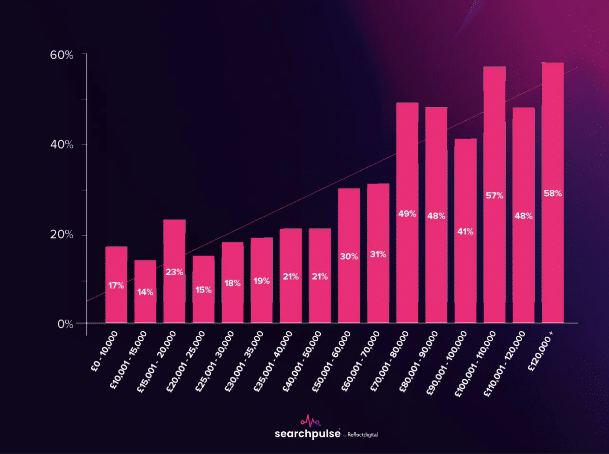
Graph taken from searchpulse report
Takeaway 3: Our audiences don’t search depending on the platform; it depends on how they feel
Human behaviour is an interesting topic because it’s always evolving. 10 years ago we wouldn’t of dreamed of ditching Google to search on TikTok or even use artificial intelligence. We were scared of robots taking over the planet…
Founder and CEO of Reflect Digital, Becky Sims opened our eyes to design for human discovery using these 5 steps:
- Behaviour – who is your network made up of, what kind of searchers are they? We need to understand their motivations whether its finding out what others are doing, discovering content to suit their taste, or simply looking for facts.
- Define the jobs – understand what they are actually trying to do. People don’t search for keywords they search to make progress. So is your audience exploring, comparing, deciding or validating…?
- Design for the platform – we want to accommodate our audience. We can map their experience based on inspiration (TikTok or Instagram), validation (YouTube or Reddit), and information (Google or LLMs).
- Format should be behaviour-led – if your audience is on TikTok we should supply them with short videos. If your audience is using AI, we should structure our content to suit and provide suitable answers.
- Who says it matters – who your message is coming from will have weight. If your brand is speaking, it needs to be underwritten with what you stand for. User-generated content is all about your audience’s voice, what are they saying about you? Influencers’ voices in your industry are trusted, they humanise your brand story. Finally, the media’s voice, these platforms and publications can extend your reach and authority.
Takeaway 4: Your brand is on trial when it comes to LLM search; if you’re not visible, you will lose
In a talk given by Christian Desert, CEO at Getfluence, he described appearing in LLM SERPs the same as putting your brand on trial. There is an art to building your case to prove your innocence. All evidence needs to be convincing and strong enough to stand up in court.
We’re all trying to get our brands found in LLM SERPs, but navigating this changing world is sometimes challenging. The journey to LLM SERPs is not about selling yourself to the LLM. They dislike promotional language, and it is not favoured – unless the search term is ‘promotions on women’s clothes’, for example. You wouldn’t use this kind of language in a courtroom, so why try and use it in the AI courtroom.
Neutral and comparative tones are favoured much more by LLMs. The neutral tone in your content will be picked up by the LLM and surfaced as its own answer. It’s important that LLMs remain neutral and always give a balanced answer. If the content you put out into the world compares two or more items from an objective standpoint, using facts and data rather than opinions or feelings, LLMs will scrape your content accordingly.
EEAT is an acronym that has been around for a long time in the world of SEO, it tells us exactly what we need our content to be. Google uses this framework to evaluate the quality of our content, it stands for: experience, expertise, authoritativeness and trustworthiness. The quality of our content is still important and will strengthen your case to appear in LLMs.
Chunked structure is also still important for LLMs to scan your content. Create short paragraphs with bulleted or numbered lists, tables and other language tactics to make your content as easy to digest as possible.
Takeaway 5: Reporting on dropping stats is something we have been dealing with across the industry
It’s a known fact that AIO (AI Overview) and AI have changed the way we search for information on the World Wide Web. Now it is harder than ever to get a user to land on your webpage. User search behaviour has changed; we want the answer now, and we don’t want to read through a ton of copy to get to it. ChatGPT enters the chat…
In order to report on these declining stats of website traffic, CTR and site referrals, we need to change the narrative.
Brands are so used to reviewing these standard metrics that it’s hard to break the pattern. However, when we benchmark our statistics next to our competitors year on year, it’s simpler to explain the change in user behaviour. Metrics like these must always have context and a rationale behind them, otherwise they mean nothing.
So there we have it, my top 5 BrightonSEO 2026 takeaways. There is lots to digest, from user search behaviour and structured SEO to navigating reporting and changing the narrative. Which takeaway has made you think differently? I have been thinking a lot about reporting and the change in user search behaviour. Users are no longer searching depending on which platform is most appropriate – there are no rules and everything is based on a feeling.
At Your Marketing Team, we’ll be regrouping to consider these new trends in our Strategic Marketing Plans. The conference was also brilliant for discovering new reporting tools which we are evaluating and will be adopting over the next quarter. For start-ups and SMEs, our advice is don’t get distracted by the all-new and shiny AI. Take a step back and review who your target audience is, the journey they take to find and purchase your product or service, and listen to what they say about you online. This behind-the-scenes research will form the basis of your digital strategy.