

The beautiful game has never been bigger business. The commercial story of this year’s World Cup reveals a fascinating insight into how sponsorship is evolving at a rapid rate and what lessons can be learned when approaching activations on a smaller scale.
Let’s be honest. Who sits down to watch a match because of Visa? Nobody. (Well, perhaps those hosted in their hospitality). The audience comes because their team or favourite player is on the pitch. The brands getting this tournament right are the ones that feel woven into the moment rather than simply being pasted across it. For some time, sponsorship has been less about media buy and more about activation. The World Cup 2026 is the perfect showcase of this at play.
The World Cup in numbers
The commercial scale of the tournament helps to frame the wider story. FIFA expects to generate in excess of $10.9 billion in total revenue for the 2023-26 cycle. This represents a 56% increase on Qatar 2022, which was itself a record at the time. Sponsorship alone is forecast to top $2.8 billion, up from $1.8 billion four years ago.* In comparison, the Paris Olympics 2024 generated approximately $5.24 billion in total revenue.
So, what sets this event apart? In part, there’s the format. The tournament will see 104 matches played across 3 countries and 16 cities over 39 days. Qatar ran a 64-game format. Then, geography comes into play. US companies now account for 52% of sponsorship (an increase from 36% in 2022), with newcomers like DoorDash and Bank of America joining the party.** In fact, FIFA had sold out all 16 global sponsorship positions before kick-off.*** A first for the Governing Body.
This is not just football, it has arguably become the world’s most commercially successful sporting event and brands want a piece of the (American) Pie.
Tapping into unique geography & cultural heritage
Hosting across 3 nations was always going to create logistical complexity. What it has also created is a commercial opportunity unlike any previous World Cup. North America brings a market that has never been fully tapped by FIFA. ‘Soccer’ has overtaken baseball as the nation’s third most popular sport, according to Ampere Analysis, and the Latino audience represents what Telemundo’s CMO, Monica Gil has called ‘the economic engine shaping the future of sports and culture in America.’
But multi-host tournaments are not simply multiple audiences. They are multiple brand conversations happening simultaneously. A campaign that works brilliantly in New York may miss the mark in Mexico City or Toronto. Unlike previous tournaments hosted within a single country, brands must now navigate diverse audiences, cultures and consumer behaviours across North America.
The brands navigating this most effectively are those that recognise localisation has become just as important as global reach.
Launched in 2023, FIFA’s own #WeAre2026 embraces this perfectly and demonstrates how they are looking at longer-term audience reach. The multi-channel campaign focuses on the communities and host-city identities, allowing local storytelling and creating user-generated content opportunities. By giving host cities ownership of the event, the campaign feels inclusive and very much integral to the collective fan experience.
Visibility vs fan experience
Visa’s ‘Tap In’ campaign is a great example of using the platform to reinforce a business purpose rather than simple brand visibility. Enlisting the star-power of Jason Sudeikis, Visa “turn the simplest goal in football into the biggest fan moments.”
Centred on contactless payment messaging, the campaign extends into small business support programmes and non-profit partnerships across all three host nations, connecting Visa’s core product proposition (tap to pay is fast, easy, universal) with a high-emotion global moment. With billions of consumers watching matches, millions making purchases inside and around stadiums, Visa makes the payment experience itself part of the fan journey.
As fan experience becomes the new battleground for sponsors, the campaigns that are resonating most powerfully are those that become a part of the story rather than interrupt it.
Match of the Day: Adidas vs Nike
No World Cup would be complete without the ultimate rivals coming head-to-head. Adidas made the first move with a short film reported to cost £50M. ‘Backyard Legends – The Greatest Football Story Ever Told’ stars a host of global football stars, past and present, alongside the-of-the-moment cultural icon Bad Bunny, celebrating nostalgia, heritage and the inclusivity of the game.
Nike’s ‘Rip the Script’ opted for something faster, more fragmented and built for the digital age. According to Camilo Andrade, Nike’s VP of Global Football, ‘The old model of one polished film doing all the work is no longer enough.’ Their campaign anchors around Kylian Mbappé, Erling Haaland and features Cristiano Ronaldo and LeBron James in a GOAT debate. With the likes of Kim Kardashian appearing as a ‘soccer mom’ with her son, Ted Lasso as himself and Channing Tatum playing an Erling Haaland body double, the campaign harnesses cultural reach way beyond the football world.
Forbes stated that “Adidas leans into soccer whilst Nike chases culture in the World Cup marketing showdown”. The real question is which campaign will outlive the tournament?
On the pitch, FIFA’s longest-standing partner and official match ball supplier since 1970, away-side Adidas can argue the heritage advantage. They are kitting out 14 nations, whereas Nike only supplies 12 teams. Nike’s line-up, however, includes football powerhouses like Brazil, France, England, the Netherlands, alongside the USA. Playing the home advantage, these are teams that are more likely to make it through to the final stages of the competition.
Beyond the pitch: It’s a lifestyle
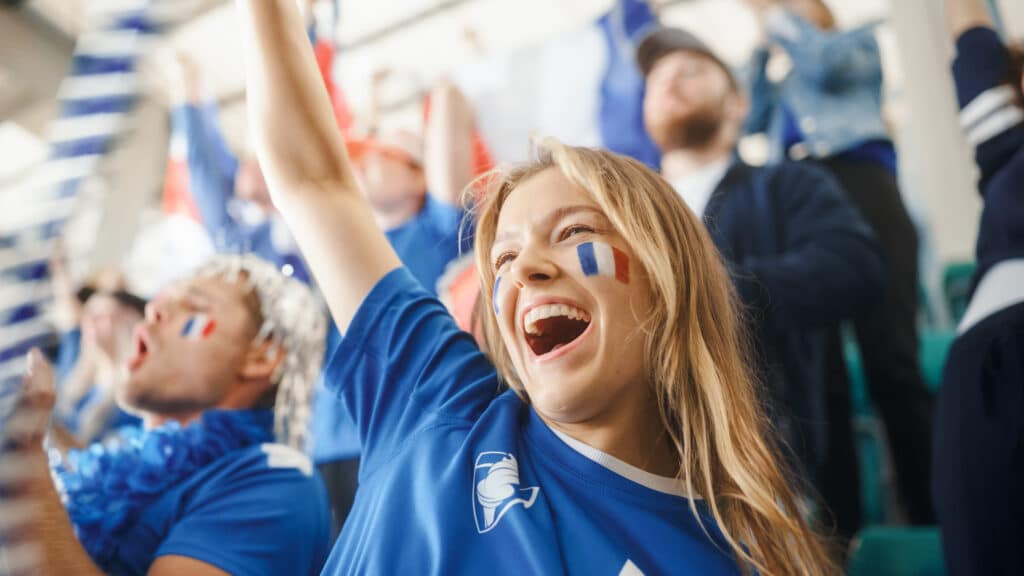
Like many global sporting properties, FIFA is transforming the tournament into a global lifestyle event. Taking a lead from the likes of Formula One, fans are engaging through music, food, fashion, social media, gaming, collectibles and live events. Fan festivals attract huge crowds, many of whom may never enter a stadium. Cities host concerts, cultural celebrations and branded experiences that extend far beyond the ninety minutes on the pitch.
And the evidence is abundant. The Kith x Adidas x Messi three-way collaboration. Street activations in New York and Toronto that look less like stadium forecourts and more like festival grounds. The ITV presenter celebrating Rashford’s goal against Croatia in Dallas citing country music superstar Ella Langley’s latest hit “He’s choosin’ Texas, I can tell”. England Captain, Harry Kane was later pictured at her concert presenting her with a personalised England shirt.
Elliott Hill, Nike President & CEO, recently said that Nike is “utilising the World Cup as an opportunity to catalyse the football marketplace for quarters to come.” This shift has interesting implications for how sponsorship is valued, activated and measured. The brands participating in 2026 are not thinking about the July final. They are operating with a longer-term vision that reaches a far wider audience beyond the event.
The art of the ambush – Levi’s & Irn-Bru
Two of the most talked-about brand moments of 2026 have come from companies that aren’t official sponsors.
Under FIFA’s ‘clean stadium’ policy, Levi’s Stadium in California, home to five tournament matches, was stripped of its branding and temporarily renamed the San Francisco Bay Area Stadium. What followed was, depending on your perspective, either a happy accident or a marketing masterclass. To comply with regulations, the famous Levi’s logo was covered with a white panel. Intentionally or not, the covering was cut to preserve the brand’s iconic ‘batwing’ silhouette. The internet noticed immediately. Levi’s swapped its social media profile picture to the covered logo, uploaded a video to the trending TikTok ‘Nobody’s Gonna Know’ audio clip, accumulating 70 million views, and turned a compliance requirement into a global brand conversation.
Irn-Bru’s approach was different in execution but similar in instinct. Scotland’s return to the World Cup for the first time in 28 years gave AG Barr’s fizzy drink brand a cultural moment it has spent decades waiting for. Created with Lucky Generals, the campaign is a brilliant reimagining of the 1980s ‘Made in Scotland from Girders’ anthem, starring Susan Boyle, Scotland captain John McGinn and Franz Ferdinand frontman Alex Kapranos, following Tartan Army fans through eye-watering ticket prices, airport security and Miami heat. It was launched like a music release, premiering on Capital FM Breakfast Show, with Spotify streams, vinyl drops and OOH at Scottish airports.
The result? System1’s independent ad effectiveness testing named Irn-Bru the consumer favourite across 130 World Cup-themed ads tested globally, ahead of campaigns from brands far outspending Irn-Bru.
Neither Levi’s nor Irn-Bru paid for official sponsorship rights, yet both achieved more awareness than many who did. The reason is simple for both brands: they understood their audience, knew where to find them, and gave them something genuinely worth sharing.
What can SMEs take away?
Most businesses will never sponsor a global sporting event. However, the most valuable lessons from this World Cup have very little to do with billion-dollar sponsorship deals.
The brands scoring today know exactly what they stand for, who they want to reach, where those audiences spend their time and how to improve their experience. Importantly, they are looking at a longer-term goal by showing up consistently and authentically across all touchpoints, holding firm to their core proposition and values.
This rings as true for a local independent SME as it does for Adidas or Visa. In fact, smaller businesses often have an advantage here. Authenticity is easier to convey and sustain when the founder is still in the room, when the team genuinely believes in the proposition, and when their audience and community begin to lean in on trust.
Often businesses will ask, “How do we get more visibility?” Yet, the better question is, “How do we create something our audience wants to be part of?”
The World Cup 2026 is arguably the most commercially sophisticated sporting event the world has ever staged. But the principles it illustrates are available to any business that recognises how to apply them.
Are you considering sponsoring a local event, club or property? Get in touch with our team to help you evaluate the opportunity and develop an effective activation strategy.
*Stats from FIFA Annual Report
** CSI Magazine
*** Sportspro.com